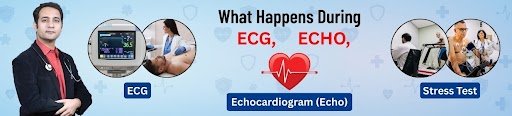
What Happens During an ECG, Echo, and Stress Test? A Simple Guide for Heart Patients
Heart-related tests can feel intimidating, especially when you are unsure what will happen inside the testing room. If your doctor has advised an ECG, Echocardiogram (Echo), or Stress Test, it usually means they want a clearer picture of how your heart is functioning, not that something is necessarily wrong.
These tests are safe, painless, and extremely common in India, performed daily in hospitals and diagnostic centres. Understanding the process can reduce anxiety and help you feel confident and prepared.
Why Doctors Recommend Heart Tests
Your heart works nonstop, pumping blood to every part of the body. Even small issues can affect overall health. Doctors may suggest these tests if you have:
- Chest pain or discomfort
- Shortness of breath
- Palpitations (racing or irregular heartbeat)
- Dizziness or fainting spells
- High blood pressure
- Diabetes or high cholesterol
- Family history of heart disease
- Pre-surgery evaluation
- Routine cardiac check-up after age 35–40
Each test looks at a different aspect of heart health.
1) What Happens During an ECG (Electrocardiogram)
What an ECG Measures
An ECG records the electrical activity of the heart. Every heartbeat is triggered by electrical signals, and abnormalities in these signals can indicate heart problems.
When an ECG Is Recommended
Doctors commonly advise an ECG for:
- Chest pain evaluation
- Suspected heart attack
- Irregular heartbeat
- Monitoring existing heart disease
- Routine health check-ups
- Pre-operative assessment
Step-by-Step: What Actually Happens
An ECG is one of the quickest medical tests, usually completed in 5 to 10 minutes.
- You lie down on an examination table
You will be asked to lie flat on your back and relax. - Electrodes are attached to your body
Small sticky pads (electrodes) are placed on:
- Chest
- Arms
- Legs
- For men, some chest hair may be shaved to ensure proper contact.
- Wires connect electrodes to the ECG machine
These wires only record signals – they do NOT deliver electricity. - You remain still for a few seconds
Talking or moving can interfere with the recording. - The machine prints a graph
The ECG tracing shows the heart rhythm and electrical patterns.
Is an ECG Painful?
❌ Not at all.
There are no injections, shocks, or discomfort. You will not feel anything except the cool gel or stickers on the skin.
What Doctors Can Detect from an ECG
- Irregular heart rhythms (arrhythmias)
- Evidence of a previous or ongoing heart attack
- Heart muscle thickening
- Electrolyte imbalances
- Effects of medications
- Conduction abnormalities
2) What Happens During an Echocardiogram (Echo)
What an Echo Measures
An Echocardiogram uses ultrasound waves to create moving images of the heart. It shows the heart’s structure, pumping ability, and blood flow.
Think of it as a sonography of the heart.
Why an Echo Is Done
Doctors may recommend an Echo to evaluate:
- Heart valves
- Heart chamber size
- Pumping strength (ejection fraction)
- Congenital heart defects
- Heart failure
- Fluid around the heart
- Blood clots inside the heart
- Damage after a heart attack
Step-by-Step: What Happens During the Test
An Echo usually takes 20 to 40 minutes.
- You lie on your left side
This position helps obtain clear images. - Gel is applied to the chest
The gel helps ultrasound waves travel effectively. - A probe (transducer) is moved over the chest
The technician presses gently and moves the probe to capture images from different angles. - You may be asked to hold your breath briefly
This reduces motion and improves image quality. - Live images appear on a monitor
The heart’s movement can be seen in real time.
Is an Echo Painful?
No. It is completely painless.
You may feel mild pressure from the probe, but nothing uncomfortable.
What Doctors Learn from an Echo
An Echo provides detailed information about:
- Heart-pumping efficiency
- Valve leakage or narrowing
- Thickness of the heart muscle
- Structural abnormalities
- Blood flow direction
- Presence of clots or tumours
- Congenital defects
It is among the most informative noninvasive cardiac tests available.
3) What Happens During a Stress Test
What a Stress Test Evaluates
A Stress Test assesses how the heart performs during physical exertion. Some heart problems appear only when the heart works harder.
This test is also called:
- TMT (Treadmill Test)
- Exercise Stress Test
Why Doctors Recommend It
You may be advised to undergo a Stress Test if you have:
- Chest pain during activity
- Suspected coronary artery disease
- Shortness of breath on exertion
- Evaluation after heart treatment
- Fitness assessment before major surgery
- Risk assessment for athletes
Step-by-Step: What Happens During the Test
A Stress Test typically lasts 20 to 30 minutes, including recovery time.
Before Exercise
- Electrodes are attached to your chest
Similar to an ECG. - The blood pressure cuff is placed on your arm
- Baseline readings are recorded
Heart rate, blood pressure, and ECG are checked at rest.
During Exercise
- You start walking on a treadmill
Initially slow and easy. - Speed and incline gradually increase
Every few minutes, the intensity rises. - Your heart activity is continuously monitored
- You report any symptoms
Such as chest pain, dizziness, or breathlessness.
After Exercise
- You slow down and stop
- Monitoring continues during recovery
- Test ends once heart rate returns toward normal
Can the Test Be Stopped Anytime?
Yes. The test is closely supervised and stopped immediately if:
- Severe chest pain occurs
- Blood pressure changes significantly
- ECG shows concerning patterns
- Patient feels unable to continue
Safety is the top priority.
Is a Stress Test Safe?
For most people, yes.
Medical staff are present throughout the procedure, and emergency equipment is readily available.
What Doctors Can Detect
- Reduced blood flow to the heart muscle
- Blockages in the coronary arteries
- Exercise-induced arrhythmias
- Fitness level and endurance
- Effectiveness of heart medications
How to Prepare for These Tests
For ECG
- No special preparation required
- Wear comfortable clothing
- Avoid oily lotions on the chest
For Echo
- Usually, no fasting is needed
- Wear loose clothes
- Follow instructions if any medications need adjustment
For Stress Test
Your doctor may advise:
- Avoid heavy meals before the test
- Wear walking shoes and comfortable clothes
- Avoid caffeine for several hours
- Discuss medications beforehand
- Bring previous reports
Always follow the specific instructions given by your hospital.
Are These Tests Enough to Diagnose Heart Disease?
These tests provide crucial information, but doctors often interpret them along with:
- Medical history
- Physical examination
- Blood tests
- Risk factors
- Symptoms
In some cases, further tests like CT angiography or coronary angiography may be needed.
Frequently Asked Questions (FAQs)
Are ECG, Echo, and Stress Test painful?
No. All three tests are non-invasive and painless. You may feel slight pressure during an Echo or fatigue during a Stress Test, but no significant discomfort.
How long does each heart test take?
Do I need to fast before these tests?
Can these tests detect a heart attack?
Is the Stress Test safe for older adults?
Can I take my regular medications before the tests?
Regular screening, healthy lifestyle choices, and timely medical consultation, especially under the guidance of the Best Cardiac Surgeon in Gorewada, Nagpur, can significantly reduce the risk of heart disease. Do not ignore warning signs, particularly if you have risk factors like diabetes, high blood pressure, or a family history of heart problems.
Don’t ignore warning signs from your heart. Get accurate diagnosis and expert cardiac care at Synergy Multispeciality Hospital – where advanced technology meets compassionate treatment. Book your heart check-up today for peace of mind and a healthier tomorrow.
.svg)
.svg)